Change one thing at a time and judge it in the mix. The settings that help a soloed track may not help the song.
EQ: solve one audible problem
Listen with the arrangement playing. Identify what is masking the voice before reaching for an EQ: low-frequency build-up, a midrange resonance or excessive brightness are different problems.
Make a small move and compare at a similar level. If you use a low-cut filter, raise it only until unwanted low-frequency energy is controlled, then check that the voice still has the body it needs.
Compression: decide what needs controlling
For broad levelling, try an optical-style compressor such as The 3A. For more explicit control over attack, release and ratio, choose a compressor that exposes those controls, such as Console Compressor. This is a workflow choice, not a promise that one design suits every singer.
Begin with modest gain reduction. Listen to word endings and the start of each phrase. An attack that is too fast can soften articulation; a release that does not fit the performance can make the level movement obvious. Match output level when bypassing.
To compare compressors fairly, use the same passage and similar output loudness. Judge intelligibility, movement and tone before looking at the meter.
Reverb: create space without losing words
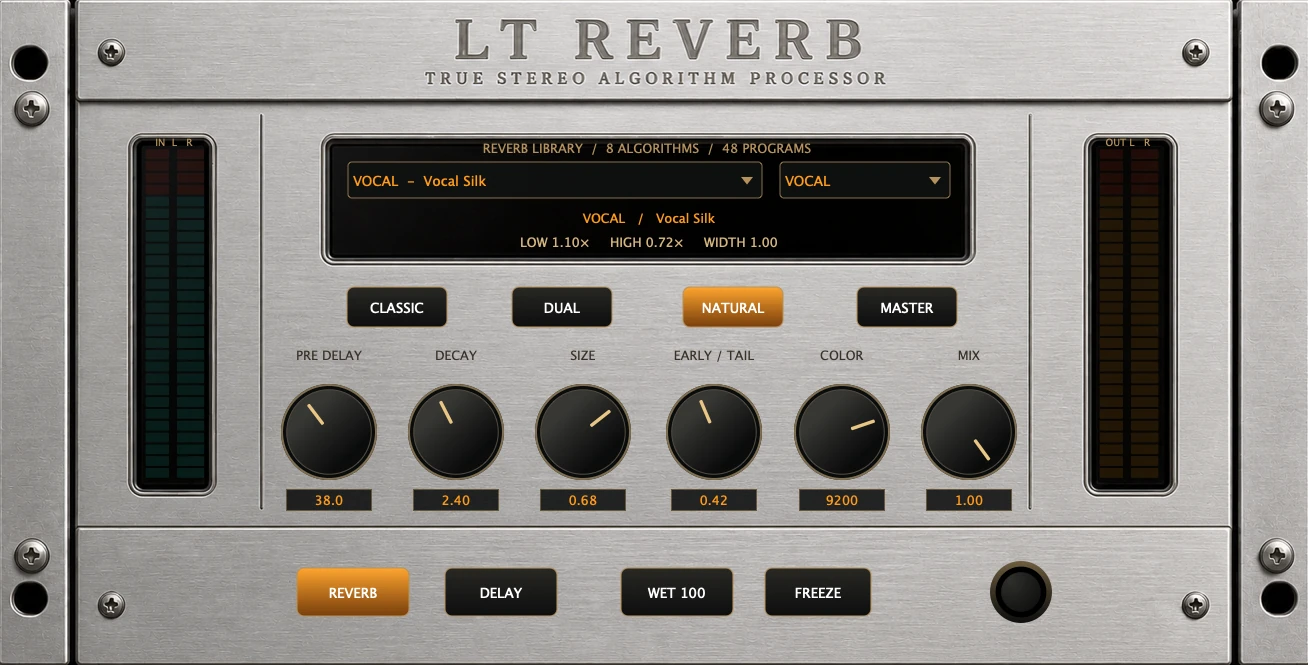
For a send effect, use a separate return and set the reverb fully wet. Raise the send until the space is audible, then lower it slightly and listen in context.
If the vocal becomes distant or unclear, shorten the decay, reduce the send, or adjust pre-delay where available. LT Reverb offers different algorithms: compare a few with the same phrase instead of assuming that the largest space is the best fit.
Check the combined result
Bypass the whole chain and match perceived loudness. The useful question is whether the vocal now sits better in the arrangement. If it only sounds louder, revisit the processing.
Save your settings as a starting point for this session. A different singer, microphone or arrangement will usually need a fresh listening decision.